
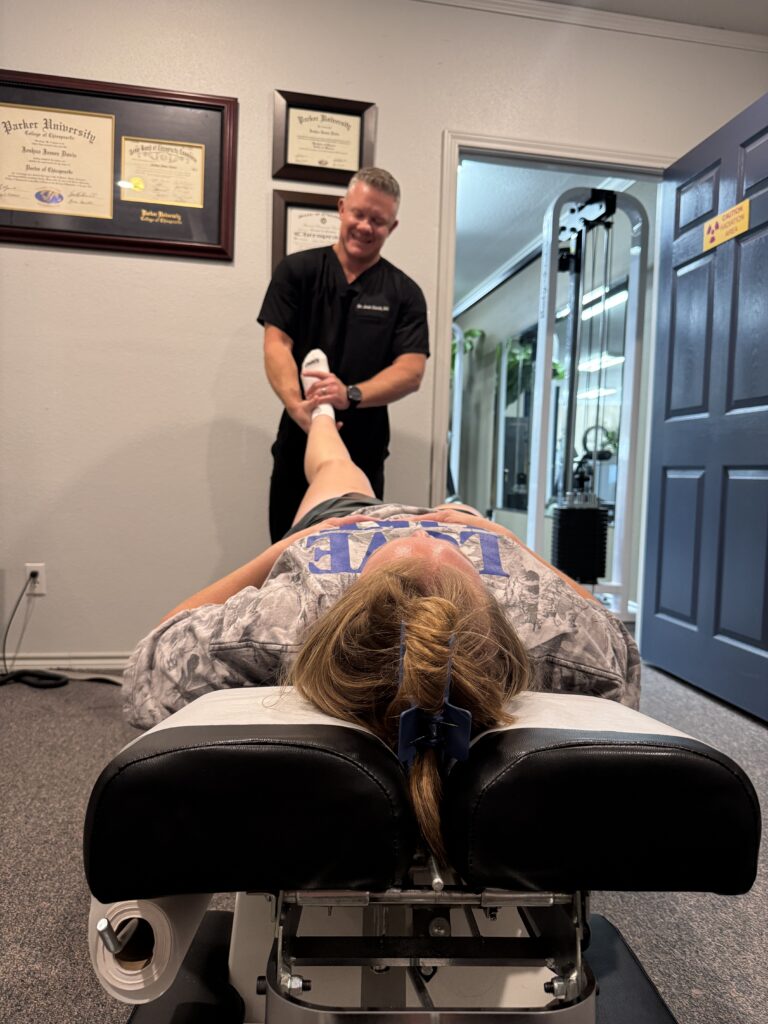
What is an extremity adjustment?
The joints of the arms and legs can become stiff or move less freely after an injury, overuse, or long periods of limited activity. An extremity adjustment uses a precise, controlled movement to help a restricted joint move more normally.
Because many of these joints are smaller than spinal joints, extremity adjustments are often gentle and very targeted.
Who this care may be appropriate for
People with stiffness or discomfort in a shoulder, elbow, wrist, hip, knee, ankle or foot commonly ask about extremity adjustments. Recent fractures, joint replacements, or signs of infection or significant swelling need a different approach, and Dr. Davis may recommend imaging or a referral first.
Common reasons patients ask about it
- Shoulder, elbow or wrist pain
- Hip or knee pain
- Ankle or foot pain
- Joint stiffness after an injury
Commonly used as part of care for
Individual results vary. Your care plan depends on your exam and health history.
What to expect
Health history and exam
Dr. Davis reviews your health history and examines the area of concern. Your first visit takes about 30 minutes.
Your options, explained
You hear the exam findings and whether this care is a reasonable option for you. You decide how to proceed.
The treatment
Dr. Davis compares how the joint moves with the other side and checks the joints above and below it, then explains whether an adjustment is appropriate. Extremity adjustments are often combined with spinal care or dry needling.
Follow-up
Dr. Davis checks how you responded and adjusts the plan as needed.
Questions about extremity adjustments
Can a chiropractor help with knee or shoulder pain?
Chiropractors commonly evaluate and treat joint problems in the arms and legs. Whether it's a good fit depends on the cause, which is what the exam is for. See knee pain and shoulder pain for more.
Is an extremity adjustment different from a spinal adjustment?
The idea is the same: a controlled movement to help a restricted joint move better. The technique is adapted to the size and structure of each joint.
Do I need to bring imaging?
No. You don't need to bring anything to your first visit. If you already have X-ray or MRI reports of the joint, you're welcome to share them.

Last reviewed October 2026